A fixture is a plan with conditions
A published cricket fixture tells a reader what is intended to happen. It does not, by itself, establish that play has started, that a match has finished or that every detail remains unchanged. The useful question is not whether schedules can ever be trusted. It is which part of the listing you are relying on, and whether you have checked the notice that governs that detail. A little precision prevents many avoidable misunderstandings.
This note explains how to read a schedule as evidence. It is not a current fixture feed and does not announce changes for any competition. The retained historical address belongs to an earlier sports edition; the present material is an English cricket explainer. Visit the Sportshjørnet reading desk for the connected notes on live information, selection and comparison. All examples below are fictional and deliberately simple.
Write the full date first
A day and month are not enough when a listing may be viewed in another season. Add the year, and check whether a page describes the original schedule or a revised one. Search results and saved screenshots can retain old wording long after a current listing has changed. A familiar opponent pairing does not establish that two pages are discussing the same event. Give each fixture an identity before comparing its details.
The same care applies to a time. A displayed start time needs a time zone or an explicit local context. If that information is absent, report the absence rather than silently converting the number into your own zone. A conversion is a factual step with inputs, not a cosmetic change. For a personal viewing plan, verify the event's current official listing before making arrangements that depend on a precise hour.
Separate scheduled time from actual play
A scheduled start describes an intention. An observed first delivery describes something that happened. A status label may communicate a delay, but its meaning depends on the source and the wording used. Do not infer the reason for a delay merely from an empty score panel. The absence of a recorded event is weaker evidence than a notice that directly explains the state of the match.
Imagine a fictional fixture listed for 14:00. At 14:15, one page still shows only the fixture details. That does not prove the match has been abandoned, moved or started late. It proves only that this page has not supplied a record of play at the time you looked. A responsible update would seek a current announcement and keep the gap visible until the announcement is found.
Identify the format and competition
A date does not tell you how the contest is structured. The format affects what a spectator should expect from an innings, a day's play or a completed match. The ICC introduction to international formats distinguishes several international structures. A domestic or community competition may have its own arrangements, so its specific documentation matters when the general overview is not enough.
Do not turn a familiar format label into an assumption about every operational detail. Replacement procedures, revised schedules and local administrative decisions require their own relevant source. The broader lesson is about scope: use a document for the claim it actually supports. A general introduction helps identify the type of cricket; a current competition notice establishes a specific change in that competition.
Compare two versions without guessing
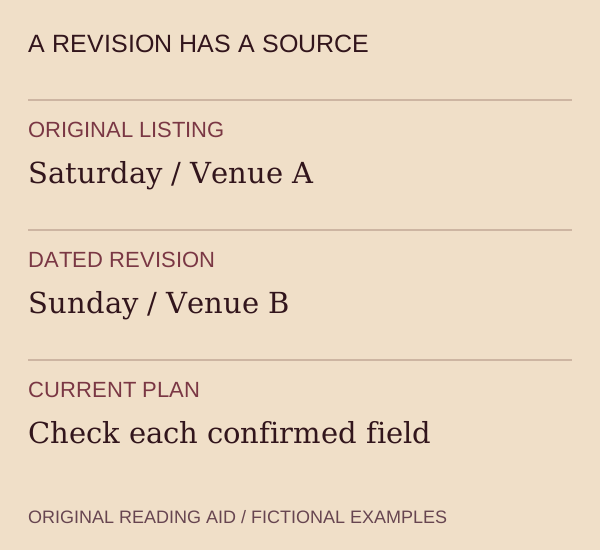
Suppose an invented schedule first lists Harbour versus Valley on Saturday at one venue. A later notice lists the same pairing on Sunday at another venue. Record both versions with their publication or update information. Then identify what the newer notice explicitly replaces. The diagram accompanying this note shows a simple chain: original listing, dated revision, current confirmed plan. It does not represent a real fixture.
A revision can be narrow. A changed venue does not automatically imply a changed start time, and a changed date does not establish why the organisers made the decision. Keep each field separate: teams, competition, date, time, zone, venue and status. This prevents a reader from filling gaps with a plausible story that the notice never actually supplied. Plausibility is not a substitute for an announcement.
When sources disagree, prefer the one with direct responsibility for the relevant detail and a clear current notice. If you cannot resolve the disagreement, describe it rather than choosing whichever version fits your plans. Linking to the notice allows another reader to check the same evidence. A confident but unsupported correction can be more disruptive than a brief, accurate statement that the detail remains unclear.
Think about the reading consequences
A revised schedule changes more than a calendar entry for someone comparing sporting records. The sequence of matches, the gap between appearances and the format being discussed may all affect the comparison. These are questions to investigate, not automatic explanations for performance. A reader should not infer fatigue or a medical issue merely because two fixtures appear close together. The public schedule cannot establish a private physical condition.
What it can establish is the arrangement of opportunities in the published plan, subject to subsequent changes. A clear analysis names that arrangement and avoids pretending it determines the result. The team comparison note shows how to keep contextual differences visible when discussing results. A schedule is one part of that context, alongside the sample, opponents and match format.
Preserve the source trail
For a useful notebook entry, save the exact notice address and the date you checked it. If you record an earlier version, label it as earlier rather than leaving two apparently current entries side by side. You do not need a complicated database. A small list of source, revision and affected fields is enough to explain why your understanding changed. The method scales from one evening's viewing to a longer competition review.
If the notice is subsequently corrected, update the dependent claims. A changed date may alter a written statement about sequence. A changed venue may invalidate an assumption about location. A routine correction does not require a dramatic explanation, but it does require following the effect through the paragraph. Clear source trails save effort because the dependencies are visible instead of buried in memory.
Keep explanations in their proper place
Readers often want to know why a schedule changed. Sometimes an organiser gives a reason; sometimes the available notice simply announces a new arrangement. Respect that difference. Do not attribute the decision to a dispute, a commercial motive or an individual without evidence. An explanatory article should make the known change easier to understand rather than turn the absence of an explanation into an invitation to invent one.
For additional terminology, Cricketin's English guides are a sponsored reading reference. They are not the source of the fictional revision described here and do not govern a competition's calendar. The strongest final summary remains specific: this source announced this change, at this time, to these fields. Anything beyond that should be identified as an open question or supported by another source that actually answers it.
Keep the practical note short
For your own viewing plan, finish with a compact current entry rather than a history of every rumour. Include the event identity, the confirmed fields and the source you last checked. Keep earlier versions separately if they explain a revision. This gives the note two useful properties: it is easy to act on, and it remains possible to reconstruct why it changed. Neither property requires inventing certainty about details that the organiser has not confirmed.