Opportunity belongs beside output
A developing player's record is often read as a simple progression from weaker numbers to stronger ones. Real observations are rarely so tidy. Roles change, opportunities vary and a memorable contribution can occupy much more attention than the ordinary passages around it. A useful reading method records what the player was asked to do and how much chance there was to do it. Output becomes more meaningful when opportunity is visible beside it.
This note offers a way for spectators to organise observations. It is not a coaching prescription, a health assessment or an inside account of a player's career. The older address remains available, but the text is a new cricket edition with a current update date. The Sportshjørnet homepage places this framework alongside notes about selection, match information and fair comparisons.
Define the question before watching
Choose one observable question for a passage of play. You might be interested in how a batter responds after several deliveries without scoring, or how a bowler varies a visible approach across a spell. Keep the question narrow enough to describe without guessing at private instructions. An observation notebook is strongest when another viewer could understand what you recorded and distinguish the event from your interpretation of it.
Avoid turning the exercise into a diagnosis of confidence, motivation or character. A scorecard cannot establish those things, and a broadcast clip does not grant access to a person's private state. You can describe an observable choice and explain why it interested you. That is already worthwhile. The more ambitious claim about what the choice reveals about the person needs evidence of a different kind.
Record the available exposure
For batting, note the amount of opportunity as well as the final score. For bowling, record the visible spell and its match setting rather than relying only on an aggregate result. The precise fields depend on your question; they are not a universal grading sheet. What matters is that a short appearance and a long appearance are not silently treated as equal evidence for every possible claim.
Imagine two invented observations. In one, a player faces six balls near the end of an innings. In the other, the same player faces thirty balls in a different match state. The raw runs may be discussed, but the opportunities are different. Any comparison should state that difference before declaring improvement or decline. The purpose is not to excuse every result; it is to explain what the evidence actually contains.
Keep description and judgement apart
A useful entry has a description first and an interpretation second. The description might record a sequence of scoring and non-scoring deliveries. The interpretation might suggest how that sequence affected the innings. By keeping the sentences separate, you allow the factual record to survive even if you later reconsider the explanation. This is more useful than a single evaluative label such as promising or disappointing.
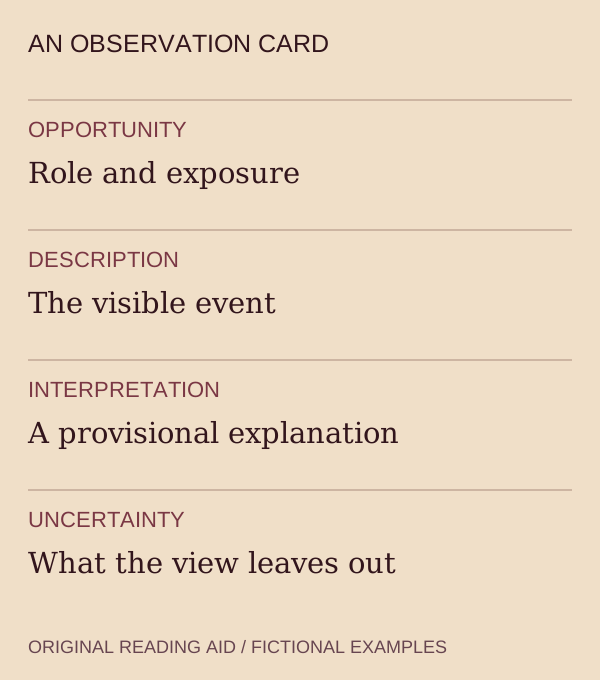
Add an uncertainty line when the view is incomplete. A highlight clip may begin after an important passage, and a camera angle may not reveal a field arrangement clearly. Record those limits directly. Missing information should not become invisible simply because the writing needs a neat ending. The diagram shows an original four-part observation card: opportunity, visible event, interpretation and uncertainty. It is a reading aid rather than a professional scouting instrument.
A small invented example
Suppose a fictional batter called Player A records 12 runs from 8 balls in one appearance and 18 from 18 in another. The first innings has the higher scoring rate; that fact alone does not establish which was the more useful contribution. We have not specified the team position, the task, the format or the available alternatives. A development claim based only on the two rates would ask the figures to answer more than they can.
Combining the two appearances gives 30 runs from 26 balls. That combined rate describes the combined invented sample. It does not remove the contextual differences between the appearances or prove that the player has reached a stable level. Aggregation can simplify a record while concealing changes inside it. Keep the underlying observations available so that the summary can be checked rather than treated as an unexplained verdict.
The next useful step is to ask which additional observations would help answer the original question. Perhaps the issue concerns decision-making in a particular role rather than scoring speed overall. A relevant third observation may be more informative than several unrelated totals. This is a principle of organising evidence, not a promise that enough notes will make a player's future predictable. Sporting development remains uncertain even when the record is carefully kept.
Resist the highlight effect
Highlights are selected for interest, not designed as a complete sample. A spectacular boundary or a dramatic wicket can show a genuine moment of skill while leaving the surrounding sequence out of view. Enjoy the moment, but avoid letting its availability determine the whole assessment. If your discussion concerns consistency, you need to know what was included and what was omitted from the material you watched.
This is particularly important when comparing two people. One may have a widely shared compilation while the other appears only in a sparse scorecard. The difference in presentation is not evidence of a difference in ability. State the asymmetry and moderate the conclusion. The comparison framework develops this point by asking whether the samples have been assembled on comparable terms.
Connect development to selection carefully
A team has immediate tasks; a developing player may also need opportunities to learn. Public observers can recognise that those questions are related without claiming to know how a particular team balances them. Do not invent a private development plan to explain an appearance. If an official statement describes a role, identify the statement and its scope. If no explanation is available, keep your role map provisional.
The selection note asks readers to begin with jobs rather than names. Combined with an opportunity log, that method can produce a more useful discussion than ranking players from one recent score. It also leaves room to recognise different kinds of contribution. A narrow statistic is not wrong because it is narrow; it becomes misleading when its limited scope disappears from the conclusion.
Use a modest language of progress
Prefer a sentence that says what changed in the observed sample to one that announces a permanent transformation. You might describe a different role, a larger opportunity or a visible adjustment in a particular sequence. Those claims can be examined. A sweeping statement about a player's ceiling or mentality cannot be established by the small notebook exercise described here. Keeping the claim modest makes the discussion more credible, not less interesting.
For rules context, consult the MCC explanation of the Laws and playing regulations. For additional cricket vocabulary, Cricketin's English reading pages are a sponsored partner reference. Our fictional figures and observation card are original explanatory material. They do not represent a real player's record, a professional assessment or a recommendation to make decisions about a person on the basis of a short sample.
Make room for ordinary performances
A record built only from the best and worst appearances has its own selection problem. Ordinary contributions show what happened between the moments that attracted attention. Include them when they fall inside your chosen boundary, even when they do not support an exciting narrative. The result may be less dramatic than a highlight compilation, but it offers a more honest basis for describing the period you observed. A quieter account can still reveal useful questions about opportunity and role.